
As of August 2025, the median operating margin at non-profit health systems was 1.1%.
With margins this thin, every avoidable dollar spent on energy costs and infrastructure hits the bottom line harder than ever. That’s why our work helping essential hospitals identify and act on cost-saving energy projects has never been more important.
Essential hospitals often operate under unique constraints: aging infrastructure, high patient demand, and limited capital for long-term improvements. To address these constraints, Oakwell partnered with Practice Greenhealth, America’s Essential Hospitals, and Health Care Without Harm to launch the Decarbonization & Resilience Cohort, funded by the Wells Fargo Foundation and The Commonwealth Fund.
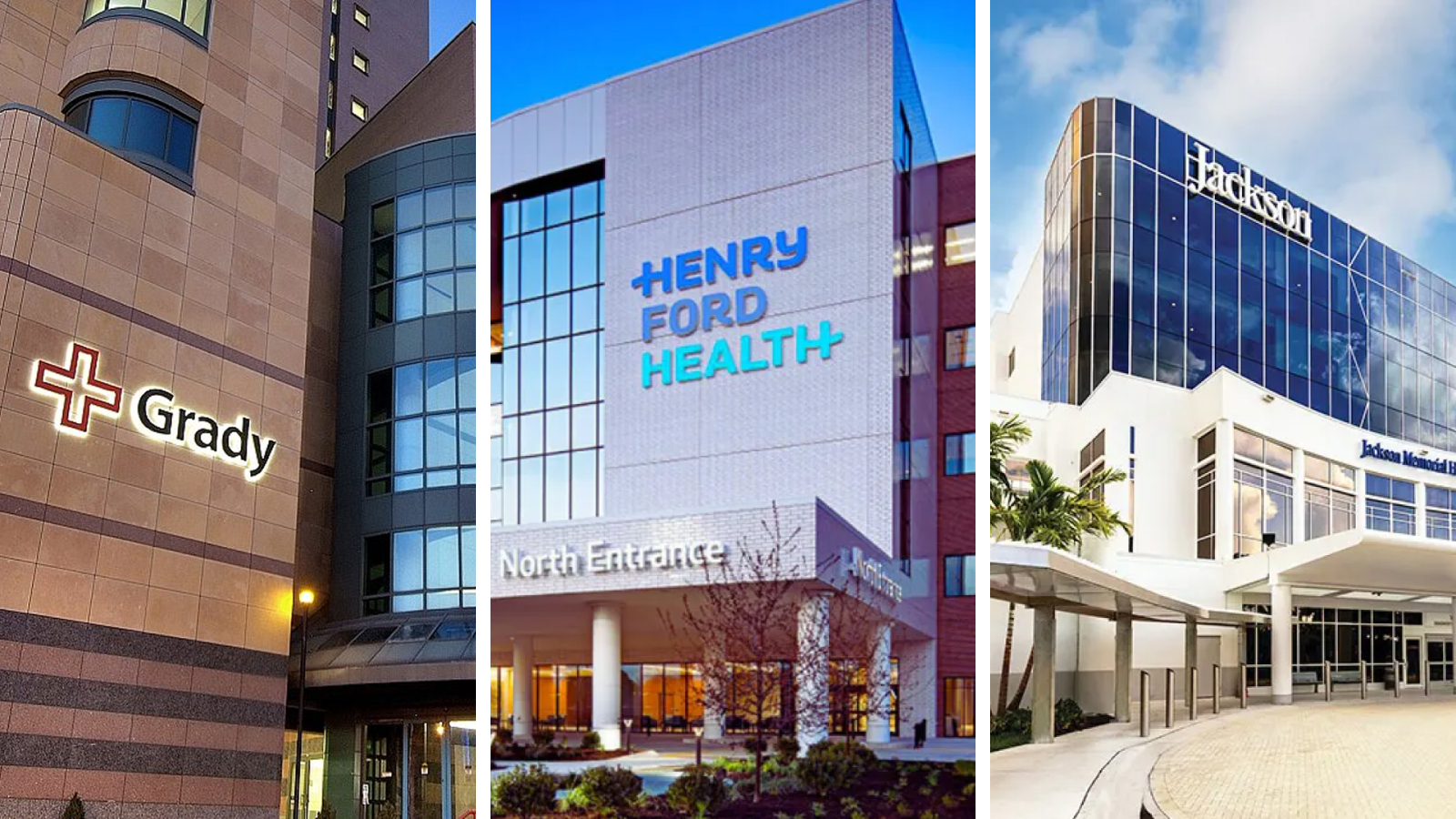
Grady Memorial Hospital, Henry Ford Wyandotte Hospital, and Jackson South Medical Center are the participants of this innovative pilot cohort. Oakwell acted as their ‘boots-on-ground’ engineering and delivery partner —conducting on-site facility assessments, sequencing Energy Conservation Measures (ECMs), and developing detailed decarbonization and implementation roadmaps tailored to each hospital’s financial and operational realities. Our goal was simple: give essential hospitals the clarity and resources to pursue energy projects that create cost savings, improve resilience, and strengthen care environments.
What Makes This Cohort Unique
Hospital infrastructure decisions are often made with shifting goal posts — partial information, in-progress drawings and similar uncertainties —leading to mispricing, delays, heavy contingencies and costly change orders. This cohort replaces guesswork with data: real field assessments, engineered Energy Conservation Measures (ECMs), sequencing logic, and sound, modeled ROI. This provides hospital leaders with a transparent, multi-year implementation plan they can prioritize and trust, along with direct support for financing transformative projects. It’s actionable intelligence that reduces risk and drives measurable financial returns.
Our team was onsite, in mechanical rooms, profiling systems, analyzing loads, and modeling the long-term savings that smarter energy investments can deliver. These roadmaps are already revealing significant cost-saving potential.
Highlights From Cohort Participants
Grady Memorial Hospital, Georgia
Grady Memorial Hospital is a 953-bed acute care teaching hospital and Atlanta’s only Level I Trauma Center, making it an indispensable source of care for its community.
The cohort’s energy audit and decarbonization assessment revealed an opportunity for Grady to replace its offsite steam plant with an onsite system that will lower the hospital’s annual energy consumption per square foot by 10%. Over the 40-year life of the new steam plant, it would save Grady Memorial Hospital an estimated $30 million compared to an offsite replacement. This change would also reduce Grady’s environmental pollution by a projected 2,500 metric tons of carbon dioxide equivalent, which is similar to the impact of taking 583 cars off the road annually. Grady’s implementation roadmap consists of 14 energy conservation measures spanning over the next 25 years.
With all of the energy efficiency improvements Grady is implementing, the hospital may qualify for incentives from its utility provider (Georgia Power) as well as the federal Energy Efficient Commercial Buildings Tax Deduction available for nonprofit allocation on projects started before mid-2026. Grady’s potential heat recovery chiller and solar installation may also qualify for the Clean Electricity Investment Credit. Oakwell is also evaluating grants from the Georgia Environmental Finance Authority.
Henry Ford Wyandotte Hospital, Michigan
Henry Ford Health Wyandotte Hospital is a 322-bed facility with one of the busiest emergency departments in Michigan, handling more than 60,000 emergency room visits each year. The Wyandotte Hospital is also one of Henry Ford Health’s most energy-intensive facilities, and Phil Guster, the system’s director of sustainability, used the cohort to identify and pursue climate-smart upgrades.
Wyandotte Hospital’s energy audit and decarbonization assessment identified an opportunity to move the hospital building off the municipal steam system and on to a localized, lower-emission solution. While steam will always be necessary for sterilization and other needs at the hospital, Oakwell also identified an opportunity to offset some of Wyandotte Hospital’s energy needs by replacing indoor heating units that are past their useful life with heat pumps powered by water from the Detroit River. Both opportunities are still being explored to ensure all local regulations are complied with and the most cost-effective solutions are employed.
To turn its vision into reality, Henry Ford Health is preparing to leverage a diverse range of funding sources, from federal tax incentives to state level funding through Michigan Saves and emerging collaboratives like the Michigan’s Climate Investment Hub.
Jackson South Medical Center, Florida
Jackson South Medical Center is a 262-bed acute-care Level II trauma center located in Miami-Dade County. It is the southernmost hospital that provides trauma services, making it a vital source of care for not only Miami but much of southern Florida.
Jackson South’s ongoing energy audit and decarbonization assessment is evaluating the feasibility and financial support available for onsite renewable energy generation and storage, as well as additional energy efficiency upgrades to Jackson’s water and power systems. Upgrades like reducing air changes overnight and on weekends in unused operating rooms can help Jackson South conserve energy and save money. Another key energy efficiency project under evaluation is installing heat recovery chillers that recover heat wasted by cooling towers so that it can be used by the hospital.
The cohort is evaluating funding opportunities to support Jackson South’s prioritized projects, including federal tax incentives, utility incentives, and philanthropic grants.